
Advertisement
It’s surprising, but over 60% of U.S. adults now use voice-enabled AI assistants every day. This change is making virtual assistants key helpers at home and work.
This article talks about how AI assistants boost efficiency and cut down on manual tasks. They help people manage their time better. Tools like Google Assistant, Amazon Alexa, and Apple Siri are becoming part of our lives.
Busy professionals, remote workers, and entrepreneurs rely on AI assistants for many tasks. They use them for scheduling, reminders, and even controlling smart homes. As more people use them, they’re getting better at working with business apps and chatbots too.
Want to know more about these virtual helpers? How they’ve evolved? Which ones are leading the market? And how to use them safely and effectively? Keep reading for all the answers.
What Are AI Assistants?
AI assistants are software agents that help people get things done. They understand language, perform tasks, and connect services. You can find them as voice-enabled speakers, phone helpers, chat windows, or inside apps.
They are in homes, offices, and customer support systems. They speed up routine work and answer questions.

Definition and Overview
Also known as virtual assistants, digital assistants, or automated assistants, these systems use artificial intelligence. They understand natural language and speech recognition. Users can speak or type commands to set reminders, search the web, or control smart devices.
Examples include voice assistants like Google Assistant and Amazon Alexa. Text-based chatbots are on websites and messaging apps. Assistants are also in productivity tools like Microsoft Outlook or Slack.
They mix cloud-based services with on-device components for fast tasks. APIs and SDKs help companies add assistant features to their apps. Developers use frameworks like Google Dialogflow, Amazon Lex, and Microsoft Bot Framework. Large language models power advanced conversational abilities.
Key Features of AI Assistants
Natural language understanding and generation enable fluid conversations. Voice recognition and speech-to-text allow hands-free control for drivers and busy professionals.
Task automation includes scheduling, reminders, email summaries, and repetitive actions. This saves time. Integration capabilities connect assistants to calendars, CRM platforms, smart home devices, and third-party apps through APIs.
Personalization helps assistants learn preferences and offer context-aware suggestions. Security includes device authentication, permissions, and optional voice biometrics for sensitive operations. Scalability supports both solo users and enterprise deployments with role-based access controls.
Performance is measured by latency, intent recognition accuracy, task success rate, and user satisfaction. Real-world examples include virtual assistants from Google, Apple Siri, Amazon Alexa, and Microsoft Cortana. Plus, specialized chatbots in Slack, WhatsApp, and company support portals.
The Evolution of AI Assistants
The path from lab experiments to daily helpers took decades. Early work in speech recognition and rule-based systems set the stage. Consumer attempts like IVR systems and chatbots, such as ELIZA, showed machines could talk like us.
Machine learning and neural networks brought big changes. Deep learning in the 2010s made language and speech better. Companies moved to more complex, context-aware platforms.
Early Beginnings
From the 1950s to the 1970s, research laid the groundwork for language and decision-making. Interactive voice response systems helped banks and call centers. ELIZA and other chatbots showed machines could mimic conversations.
Milestones in AI Development
Smartphone assistants changed how we see AI. Apple’s Siri in 2011 made voice assistants common. Amazon’s Alexa in 2014 and Google Assistant in 2016 offered more options.
Transformers and large language models like BERT and GPT improved conversations. Tools like Dialogflow and Amazon Lex helped developers create better AI assistants.
Current Trends
Now, smart assistants are in speakers, cars, and wearables. Businesses use AI assistants for customer support and e-commerce. This speeds up responses and saves money.
Large language models help with tasks like summarizing and personalizing. Voice and AI assistants are becoming more versatile, anticipating our needs. Privacy and regulation are key in how data is used and these systems are designed.
| Era | Key Development | Impact |
|---|---|---|
| 1950s–1970s | Rule-based systems and early speech research | Established core theories for language processing |
| 1960s–1990s | Early chatbots and IVR | Proved practical conversational interfaces for customers |
| 2010–2016 | Siri, Alexa, Cortana, Google Assistant | Made voice assistants mainstream on phones and speakers |
| 2017–Present | Transformers, GPT, enterprise assistants | Enabled fluent, context-aware AI assistants for work and home |
Benefits of Using AI Assistants
Modern tools change how we work and live. AI assistants save time, reduce errors, and make communication smoother. Here are some ways virtual and digital assistants add value every day.
Enhancing Time Management
Smart scheduling cuts down on meeting back-and-forth. Just say, “Schedule a meeting with Sarah next Tuesday at 2 PM.” The assistant will send invites, find times, and alert you to conflicts.
Reminders and task lists keep you focused on important tasks. Users see fewer missed deadlines and quicker access to agendas and follow-ups with automated assistants.
Task Automation
Routine tasks waste a lot of time. Automated assistants can sort emails, make to-do lists, handle payments, and create reports without your help.
Connecting with apps like Zapier or IFTTT lets you automate workflows. Teams see fewer errors and can focus on strategic work.
Improved Communication
Digital assistants write emails, summarize long threads, and transcribe meetings. This helps you follow up faster and avoid misunderstandings.
They also translate languages, provide real-time captions, and suggest writing styles. Customer-facing virtual assistants offer quick responses and a consistent tone for support.
- Time saved: fewer meeting setups and faster agenda access.
- Accuracy: reduced scheduling mistakes and automated billing.
- Response speed: quicker customer replies and 24/7 availability.
Popular AI Assistants on the Market
Today, we have many smart assistants thanks to big tech companies and special tools for work. People choose based on their devices, like phones, speakers, or office software. Here, we’ll look at the best AI assistants and what they’re good for.
Google Assistant is great for searching and talking. It works well with Google services like Calendar and Maps. It’s perfect for automating daily tasks and answering questions on various devices.
Amazon Alexa is all about controlling your smart home and using skills. It helps with shopping and managing devices. Its wide support and developer tools make it a top choice for home automation.
Apple Siri focuses on privacy and works with Apple devices. It keeps data safe by processing on-device. It’s great for those who use Apple products for everyday tasks.
Microsoft Cortana is now a productivity tool for Microsoft 365. It helps with tasks like emails and reminders. It’s a favorite among businesses for its integration with Microsoft tools.
Each assistant shows what its company is best at: Google for search, Amazon for home, Apple for privacy, and Microsoft for work. This variety meets the needs of many users, from mobile to work settings.
Developers and companies are making special assistants for areas like healthcare and finance. This leads to a wide range of smart assistants, from general to specific ones for certain needs.
How AI Assistants Improve Workflows
Teams work faster when smart assistants handle routine tasks. Digital assistants turn simple prompts into action. This lets people focus on creative tasks and making judgments.
Streamlining daily tasks makes work smoother. Voice commands can create events in Google Calendar or Outlook. An assistant can turn an email into a task in Asana or Trello.
Meeting notes and action items are auto-generated and shared. This saves time and effort.
Teams switch tasks less often with chatbots and AI assistants. Engineers use digital assistants for build commands and checking logs. Managers rely on smart assistants for weekly reports and exceptions.
Streamlining Daily Tasks
Start with small automations for big time savings. Use an assistant for reminders, drafting emails, or posting meeting summaries to Slack. These steps reduce mental load and speed up decision-making.
Pilot projects show the benefits. A small engineering team can test automated build triggers. A sales group can use a chatbot to log calls into Salesforce. This approach shows gains before wider use.
Integration with Other Software
Integrations make workflow automation useful at scale. Common connections include Gmail, Outlook, Asana, Jira, Salesforce, Slack, and Microsoft Teams. APIs, webhooks, and tools like Zapier or IFTTT link these systems.
Security is key. Use OAuth for authentication, set clear permission scopes, and enable audit logging for oversight. Admin controls ensure assistants act within policy and leave a trail for compliance.
| Use Case | Tools Often Integrated | Primary Benefit | Best Practice |
|---|---|---|---|
| Calendar and Scheduling | Google Calendar, Outlook | Faster event creation and fewer double bookings | Start with meeting types that repeat weekly |
| Email to Task Conversion | Gmail, Outlook, Asana, Trello | Clear task ownership and reduced inbox clutter | Pilot with one team to tune filters and labels |
| Automated Status Updates | Jira, Slack, Microsoft Teams | Consistent reporting without manual entry | Define required fields to avoid gaps |
| CRM Logging | Salesforce, HubSpot | Cleaner records and faster follow-ups | Use role-based permissions and audit logs |
| Build and Deploy Commands | GitHub, Jenkins, GitLab | Quicker iteration and repeatable releases | Limit commands to approved users and contexts |
Measure ROI by tracking time saved and error reductions. Start with high-impact, low-risk automations. This approach helps organizations adopt AI assistants and chatbots confidently, while keeping security and governance in check.
AI Assistants in Personal Life
Our daily lives get easier with digital assistants taking care of routine tasks. They handle everything from family calendars to home automation. This frees up our time for more important things.
Scheduling and Reminders
AI assistants make setting reminders and managing family calendars a breeze. Just say, “Remind me to call Mom every Sunday,” and it’s done across all your devices. This keeps your reminders in sync on phones, tablets, and smart speakers.
They also help with tracking medication and planning trips. Location-based alerts can remind you to pick up prescriptions or drop off dry cleaning. This helps avoid missed appointments and reduces stress.
Smart Home Management
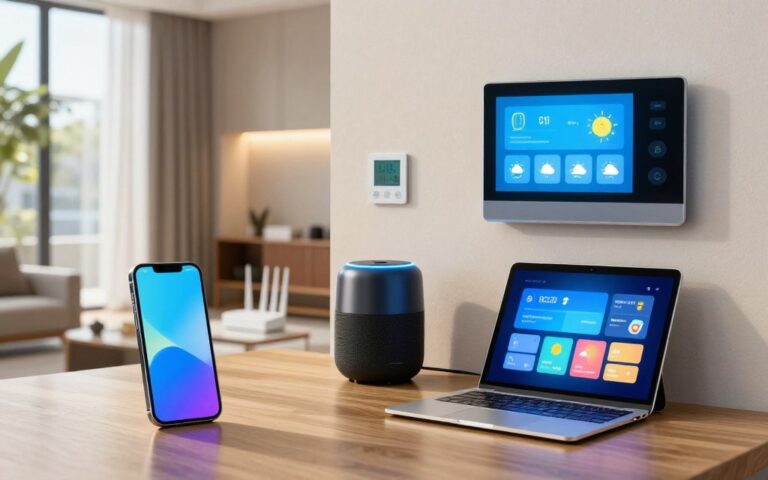
Smart assistants let you control your home with just your voice. You can set up routines like a Good Night routine that locks doors, turns off lights, and lowers the thermostat all at once.
These assistants work with HomeKit, Google Home, and Amazon Alexa, making your setup flexible. Look for Matter support for better device compatibility. Make sure your IoT devices are secure and choose hubs that respect your privacy.
Entertainment and Leisure
Voice assistants make controlling music and streaming easy. You can ask for recipes while cooking or get movie and podcast suggestions. It’s all hands-free.
They also offer accessibility benefits like reading news briefings or controlling playback for those with limited mobility. Link your favorite services and set up voice profiles for personalized results for each family member.
| Use Case | Common Tools | Key Benefit |
|---|---|---|
| Shared family scheduling | Google Calendar, Apple Calendar, Amazon Alexa | Fewer missed events and simpler coordination |
| Medication and health reminders | Apple Reminders, Google Assistant, Samsung Bixby | Improved adherence and peace of mind |
| Home routines | HomeKit, Google Home, Amazon Alexa with Matter | Automated comfort and energy savings |
| Hands-free entertainment | Spotify, Apple Music, Amazon Music | Convenient, personalized playback |
| Accessible news and briefings | Google Assistant, Apple Siri, Amazon Alexa | Improved access for users with mobility limits |
Voice Recognition Technology
Voice recognition has become a key feature in today’s devices. It makes voice assistants feel natural and useful. This technology combines several systems to quickly turn spoken requests into actions or answers.
How It Works
Automatic speech recognition (ASR) is the first step. It changes spoken words into text using acoustic and language modeling. Deep neural networks and transformer models improve accuracy, even in noisy places.
Natural language processing and understanding then work on the text. They figure out what the user wants. Dialogue management then decides the right response or action. Text-to-speech turns this into a spoken reply when needed.
Systems can run on the device or in the cloud. On-device ASR is faster and keeps data private. Cloud processing offers more power and knowledge for complex tasks.
Continuous learning makes models better over time. Exposure to different voices and phrases helps. Companies like Google and Amazon update their models to improve voice assistants.
Advantages for Users
Hands-free operation lets people do other things while using voice commands. It’s faster than typing for many tasks on phones and smart speakers.
It also helps those with mobility or vision issues. AI assistants can read messages, set reminders, and control smart home devices with simple voice commands.
Natural language processing makes tech easier to use. Voice profiles and contextual awareness personalize responses. This makes the system more tailored to the user.
But, there are still limits. Accuracy can drop in noisy places and some accents may face bias. Regular updates are needed to keep up with language changes and new uses for voice assistants.
Overcoming Legal and Ethical Concerns
AI assistants and virtual assistants make our lives easier. But, they also raise important questions about privacy and data security. This section will talk about the risks and steps to manage them, keeping services safe and useful.
Privacy issues with voice technology include how much data is recorded and stored. Many people are concerned about voice recordings, transcripts, and targeted ads. Laws like the California Consumer Privacy Act and HIPAA set limits on data use.
Users should have control over their data. They can delete voice recordings, review logs, and manage sharing consent. Companies like Google and Apple offer dashboards for viewing and removing data. Choosing assistants that process data locally can also help.
Data security needs both technical and organizational steps. Encryption, two-factor authentication, and device biometrics are key. Privacy-by-design and clear retention schedules help teams handle breaches well.
Third-party integrations are a risk. It’s important to vet skills and apps for access permissions. Regular reviews and contracts that require SOC 2 or ISO 27001 compliance help ensure accountability.
Ethical AI goes beyond security. Teams must address bias in language models and ensure fairness. Audit trails and transparency about model limits help users understand and avoid harm.
Technical standards and frameworks guide secure AI deployments. NIST guidance and industry certifications offer practical steps for building ethical AI. Companies that follow these guidelines can prove compliance during audits.
Users should review privacy settings, limit sensitive requests, and check third-party skills. Business leaders should adopt data security policies, require vendor audits, and embed ethical AI principles in product plans.
By prioritizing privacy and data security, AI assistants can be valuable without risk. Clear policies, strong controls, and ongoing transparency build trust and ensure safe, ethical innovation.
Future Trends in AI Assistants
The future of AI assistants is exciting. They will be faster, smarter, and more private. Advances in machine learning will help them understand text, voice, and images better.
Devices like smartphones and cars will have these smart models. This means faster and more private interactions.
Soon, smart assistants will learn new tasks quickly. They will need little training data. Explainable AI will make their actions clear, so users trust them more.
On-device models will reduce delays and protect personal data. This is because they work locally, not in the cloud.
Advancements in Machine Learning
Large language models and multimodal systems will make conversations deeper. Companies like Google, Microsoft, and Apple are working on this. They aim to handle images, audio, and text together.
This will lead to more natural and helpful responses. Edge computing will also make personalized assistants run privately on devices. This reduces delays and keeps personal data safe.
Predictive Analysis and Personalization
Predictive AI will guess what you need based on your schedule, location, and past actions. Assistants will suggest actions before you ask. They will also offer routines that fit your daily life.
Cross-device continuity will keep your context the same from phone to car to home hub. This makes smart assistants feel seamless in different situations. Vertical specialization will bring task-focused assistants for areas like healthcare, finance, and education.
| Trend | What Changes | User Benefit |
|---|---|---|
| On-device machine learning | Local inference for speech and vision | Lower latency and stronger privacy |
| Multimodal LLMs | Combine text, audio, and images | Richer, context-aware interactions |
| Predictive AI | Anticipates tasks and priorities | Proactive suggestions and time savings |
| Vertical specialization | Industry-specific assistants | More accurate domain advice and efficiency |
| Explainable AI | Transparent decision pathways | Greater trust and user control |
| Cross-device continuity | Shared context across platforms | Smoother, uninterrupted experiences |
AI Assistants for Small Businesses
Small businesses can really benefit from digital assistants. These tools help cut down on repetitive tasks, enhance customer interactions, and grow with a small budget. Starting small and growing as needed is a practical approach.
Cost-Effectiveness
Tasks like booking appointments, sending reminders, and managing inventory can be automated. This saves money and lets staff focus on more important tasks. You can try out hosted chatbots and virtual assistants without a big upfront cost.
Many small businesses use voice-enabled IVR for calls and chatbots for website chats. These tools are affordable and can help you save money by reducing the need for extra staff. They also help qualify leads faster and reduce missed appointments.
It’s important to weigh the cost savings against the initial setup and integration costs. You’ll also need to keep your digital assistants updated and trained to stay effective.
Customer Service Improvements
Chatbots and virtual assistants are available 24/7 to answer questions and help with simple issues. This means faster responses and higher success rates in solving problems on the first try.
These tools can also help capture leads, qualify prospects, and send complex issues to human agents. This improves conversion rates and makes agents more efficient across different channels.
Start by implementing these tools for high-volume interactions and common questions. Use conversation logs to improve scripts and ensure sensitive tasks are handled correctly.
| Use Case | Typical Tool | Primary Benefit | Key Metric |
|---|---|---|---|
| Appointment booking | Hosted chatbot | Fewer missed bookings | Reduced no-shows (%) |
| Customer support | Virtual assistants with omnichannel routing | Faster responses, higher CSAT | Average response time (mins) |
| Lead qualification | AI chatbots | Better lead-to-sale conversion | Conversion rate (%) |
| Billing reminders | Digital assistants via SMS/email | Improved cash flow | Days sales outstanding |
| Phone support | Voice-enabled IVR | Lower support headcount | Call handle time (mins) |
User Experience: Getting the Most from AI Assistants
A good user experience with AI assistants starts with setup and habits. Choose voice profiles and services that fit your daily life. Small tweaks in settings can make interactions feel more natural.
Customization Options
Set up voice profiles and timezone settings so your assistant knows who you are and when to act. Link your favorite apps like Google Calendar and Spotify for better integration. This makes your daily tasks easier.
Create custom routines for quick actions. For example, say “start my workday” to turn on lights and open your calendar. Always think about privacy when granting permissions.
Make sure accessibility settings are right for everyone. Adjust speech speed, enable captions, and pick your language. This ensures everyone can use the assistant easily.
Tips for Effective Usage
Speak clearly and test commands to get reliable responses. Start with simple tasks like setting timers. This builds trust in your assistant.
Keep your devices and software up to date. This ensures better accuracy and security. Also, check activity logs and delete recordings you don’t need.
Teach everyone in your household or team how to use the assistant. For businesses, use analytics and feedback to improve. Always have a human ready for complex issues.
If your assistant misunderstands you, check your microphone and reduce noise. Also, make sure all app integrations and permissions are correct. These steps help you use virtual assistants smoothly every day.
Conclusion: The Growing Role of AI Assistants in Our Lives
AI assistants are becoming key helpers in our daily lives. They use voice recognition, natural language processing, and connect with apps. This makes our routines faster and easier, from scheduling to managing our homes.
These smart helpers save us time and effort. They help us plan better and remember important tasks. But, we must also think about our privacy and security. It’s important to check our settings and choose the right assistant for us.
Start with basic features like scheduling and app connections. See how they improve your life. As AI gets smarter, we can expect even more tailored help. But, we need to make sure this progress is safe and controlled.
For those in the US, test AI assistants in real-life situations. See how they work and grow with them. With careful use, AI can greatly enhance our productivity. But, we must always keep our security and control in mind.